Exceptional Education and Student Services
The Florida Department of Education’s Exceptional Education and Student Services administers programs for students with disabilities, coordinates student services throughout the state, and participates in multiple inter-agency efforts designed to strengthen the quality and variety of services available to eligible students with disabilities.
Resources for School Personnel, Families, Students, and Content Creators
DCMP provides a streaming library of accessible education videos, teaching tools, and professional development opportunities. We partner with educational content creators to provide high-quality captioning, audio description, and American Sign Language (ASL) translation.
Education Through Life Stages
Birth to Age 3
Children’s Hearing Help Fund
The Children’s Hearing Help Fund will be used to provide assistance for qualifying families with minor children, from newborns to eighteen years of age for services such as hearing evaluations, loaner hearing devices, permanent hearing devices or the ongoing maintenance and replacement of the devices if necessary until the child reaches 18 years of age.
Information and statistics
- Nationally, three out of every 1,000 newborns have a hearing loss. It is the most common birth defect.
- Even mild hearing loss or hearing loss in only one ear, if undetected, has substantial detrimental consequences. Research shows that children with hearing loss in one ear are 10 times as likely to be held back at least one grade level compared to matched group of children with normal hearing. Research notes that children identified with hearing loss at birth are, by the time they enter school, one to two years developmentally ahead of their hearing impaired peers who were not diagnosed until the age of six.
- Before universal newborn hearing screening the average age at which children were diagnosed with hearing loss was 2.5 years. Very important speech-language development occurs significantly earlier and these children frequently require intensive special instruction throughout all their school years.
- Through identification of hearing loss in the first 3 months and by working with the parents and caregivers to communicate effectively with their child thereby preventing delays in language, cognitive and social development, these early identified children have the opportunity to develop on par with unimpaired peers. Without amplification and early intervention services by 6 months of age, lifelong delays in communication and learning may be expected.
- By the time a child with hearing loss graduates from high school, more than $400,000 per child can be saved in special education costs if the child is identified early and given appropriate educational, medical, and audiological services.
- Only by continuing consistent use of appropriate and well functioning amplification, can children with hearing loss continue to have the opportunity to access teacher instruction in classrooms using their remaining hearing. When the hearing aids of a school-age child need to be replaced or repaired, every day that the child is unable to hear optimally can be like a day they are absent from school!
Resources
Pre-Kindergarten through 12th Grade
Public Education Options in Florida
In Florida, there are many public education options for children who are deaf, hard of hearing or deaf-blind, which range from the state residential school (Florida School for the Deaf and the Blind) in St. Augustine to full mainstreaming in a general education classroom and many options in between, depending on the student’s educational, communication and social needs.
General education teachers and teachers of the deaf and hard of hearing work together to meet the goals of the student’s individual education plan. Educational interpreters are available in order to facilitate communication. Educational audiology services promote access to communication and instruction through the development of audition and the use of amplification.
- Florida Department of Education
- Bureau of Exceptional Education and Student Services
- State Board of Education Rule – Deaf/Hard-of-Hearing
- State Board of Education Rule – Dual Sensory Impaired
- Procedural Safeguards for Students with Disabilities
- Florida School for the Deaf and the Blind
- Resource Materials and Technology Center for the Deaf/Hard-of-Hearing
- Florida Outreach Project for Children and Young Adults who are Deaf-Blind
- Help with the IEP Process
There are also some private schools in Florida which serve students through scholarships.
Children’s Hearing Help Fund
A significant barrier to successful intervention outcomes has become very apparent since the implementation of the enactment of Florida’s Universal Newborn Hearing Screening Law, section 383.815, Florida Statutes. Following diagnosis, it is not unusual for some infants to experience delays of 6 months or more prior to hearing evaluation and hearing aid fitting due to a variety of issues primarily related to funding and/or parental uncertainty of how to proceed.
The law authorized the Florida Department of Highway Safety and Motor Vehicles to include a $1 donation check-off box on every driver’s license renewal form that allows funds to be collected to aid families who don’t have the means to pay for hearing aids for children who have been found to have a hearing loss.
Florida’s Individualized Education Program
An individualized education plan (IEP) is a written agreement which states the services that your child’s school will provide to help meet his/her educational needs.
Exceptional Education Student Services’ Contacts
Contents of the IEP
The IEP is a document that is designed to meet your child’s unique educational needs. It’s not a contract, but it does guarantee the necessary supports and services that are agreed upon and written for your child.
At the least, the IEP must contain these pieces of information: present levels of educational performance, goals, and special education and related services.
Once the IEP is written, the team has to decide how to put it into action. The school district is obligated to provide a free appropriate public education (FAPE) in the least restrictive environment (LRE). So the IEP team considers the way — to the maximum extent appropriate for both — to educate your child alongside kids without a disability. Special education is a set of services, rather than a specific place for your child to go. The services your child needs to reach the goals and objectives and how they’ll be delivered are identified. For most kids, the general education classroom will be the preferred setting, but a range of options is available, including special day classes. In addition to the above, the following are part of the IEP:
- The extent, if any, to which your child will not participate with nondisabled kids in the regular class and other school activities
- When services will begin, where and how often they’ll be provided, and how long they’ll last
- Necessary transition services (age 16 or the first IEP that will be in effect when the child turns 16)
These special factors will be considered and addressed in the IEP, depending on your child’s needs:
- Supports and strategies for behavior management, if behavior interferes with their learning or the learning of others
- Language needs as related to the IEP and as outlined in the communication plan
- Communication needs as outlined in the communication plan
- Assistive technology devices or services required in order to receive FAPE
- Necessary accommodations in the general education classroom
When you sign the IEP, it does not mean you agree with it. Your signature on the IEP form means that you attended the IEP team meeting. You will be asked to sign a different form to give your permission for services to begin for your child.
If you do not agree with the IEP, you can write “not in agreement” on the IEP beside your signature. The school may want to meet again to go over your concerns, or bring in educational professionals to consult, or hold a facilitated meeting. If you still feel that your concerns are not being addressed, you can choose to seek mediation, file a complaint with the Florida Attorney General’s office, or ask for a due process hearing.
The IEP is reviewed at least once a year. Parents will also receive a progress report regarding your child’s progress towards their IEP goals when report cards come out. However, if you or the teacher believe that your child isn’t learning or making progress, or has achieved the goals sooner than expected, a meeting may be scheduled at any time to revise the IEP. If you feel that an IEP review meeting is needed, put your request in writing and send it to the school and/or district administrator.
Work collaboratively with the staff responsible for your child’s IEP. Listen and ask questions. Ask what you can do to reinforce skills at home. You know your child best, so it is helpful to consider yourself the team leader. Have a positive attitude, even when you disagree. Remember, the team is there to help your child succeed.
Keep all relevant evaluations in a binder and bring them to the IEP meeting. There are many assessments that parents can do at home which can give you a sense of your child’s strengths and weaknesses as related to the educational setting. Parents are encouraged to and should feel comfortable with writing goals for their child, both academic and social.
IEP Resources
- 10 Questions Every Parent Should Ask at an IEP Meeting
- Accommodations for Students with Hearing Loss
- Examples of IEP Goals Based on the Common Core Standards
- Classroom Acoustics: Overview
- Informal Inventory of Independence and Self-Advocacy Skills
- Student Expectations for Advocacy & Monitoring Listening and Hearing Technology
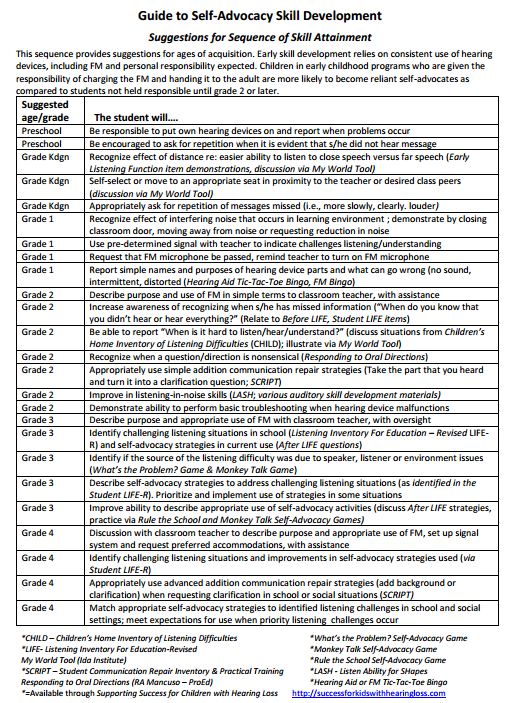
- Guide to Self-Advocacy Skill Development
- IEP Goals and Objectives Bank
- Parent to Parent Miami
- IEP Checklist