
The Brain and Spinal Cord Injury Program (BSCIP) is a short-term program that provides all eligible residents who sustain a traumatic brain or spinal cord injury the opportunity to obtain the necessary services that will enable them to return to an appropriate level of functioning in their community.
Our programs provide direct case management and resource facilitation as primary services for eligible adult and pediatric clients. This is accomplished by employing a statewide system of case managers and rehabilitation technicians.
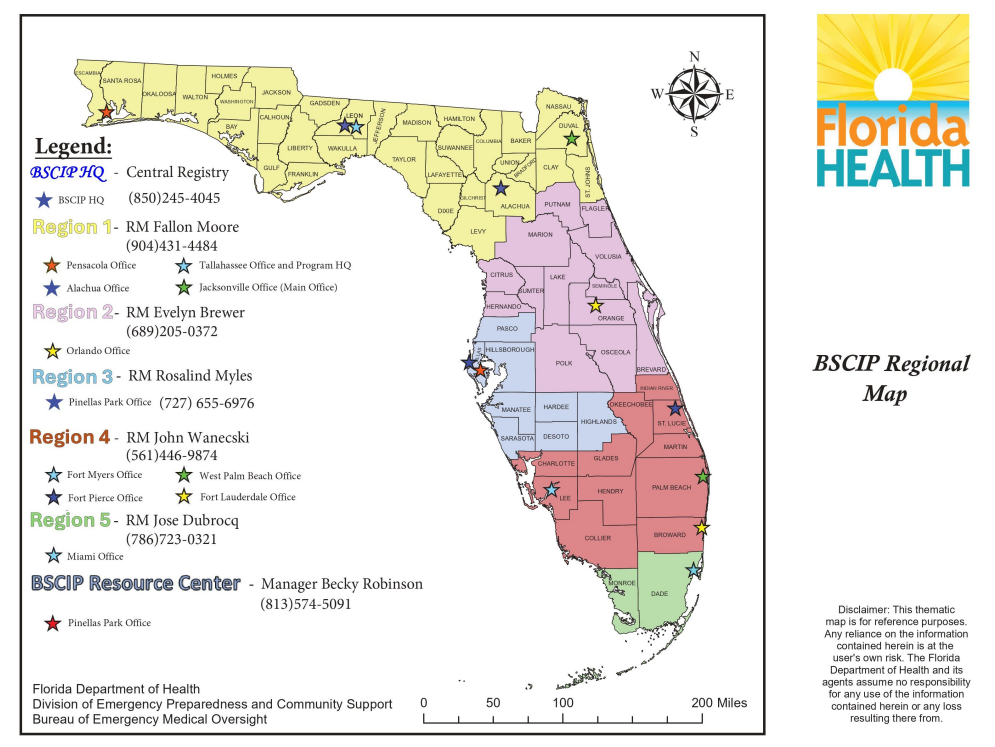
The program also employs regional managers who supervise staff in their region and who oversee the operation, development, and evaluation of the program’s services and supports at the local level.
BSCIP also supports prevention and education activities through contracts with our community-based partners. The program supports research in brain and spinal cord injuries at the University of Florida and the University of Miami.
Brain and Spinal Cord Injury Resource Center
BSCIP supports a comprehensive resource center that maintains up-to-date information pertaining to brain and spinal cord injury, assistive technology, medical, social and financial resources, and others. The resource center provides links to initiatives and programs to help individuals and their families cope with an injury and its aftermath.
BSCIP Central Registry
Facility Referral and Instructions
Self-Referral and Instructions
Florida Law requires all hospitals, attending physicians, and public, private, or social agencies refer all new traumatic moderate to severe brain or spinal cord injuries to the BSCIP Central Registry. Individuals who meet the eligibility criteria and require services and support to sustain their health and safety can provide a self-referral to the BSCIP Central Registry.
Once a referral is received, a case manager from the program will reach out within 10 business days to assess eligibility and provide information about available resources.
Traumatic Brain Injury
Definition: An insult to the skull, brain or its covering, resulting from external trauma, which produces an altered state of consciousness or anatomic, motor, sensory, cognitive, or behavioral deficit.
Traumatic Spinal Cord Injury
Definition: A lesion to the spinal cord or cauda equina resulting from external trauma with evidence of significant involvement of two motor deficit, sensory deficit, or bowel and bladder dysfunction.
Services Provided
Services provided to clients may include:
- Case management
- Acute care
- Inpatient and outpatient rehabilitation
- Transitional living
- Assistive technology
- Home and vehicle modifications
Once a client is accepted into the program, they will develop a specialized care plan based with their assigned case manager on their specific injury and needs with the goal of achieving community reintegration.
In addition to providing resource facilitation and funding, the program funds education, prevention, and research activities. It expands its services through a contract with the SportsAbility Alliance.
Other services are provided through working relationships with the Florida Centers for Independent Living and the Florida Department of Education’s Division of Vocational Rehabilitation.
Eligibility Requirements
Section 381.76, Florida Statutes, requires that an individual must be a legal Florida resident who has sustained a moderate to severe traumatic brain or spinal cord injury that meets the state’s definition of such injuries, has been referred to the BSCIP Central Registry, and must be medically stable to be eligible for services.
There must also be a reasonable expectation that with the provision of appropriate services and supports, the person can return to a community-based setting, rather than reside in a skilled nursing facility.
Non-eligible conditions
- Individuals who have had a cerebral vascular accident/stroke (CVA)
- Spinal cord dysfunction for which there are no known or obvious “injuries” to the intracranial central nervous system
- Progressive dementias and other mentally impairing conditions
- Depression and psychiatric disorders
- Mental retardation and birth-related disorders
- Neurological degenerative, metabolic, and other conditions of a chronic, degenerative nature
- Anoxic or hypoxic episodes, allergic reactions, toxic substance reactions, or any other inflammatory infections or acute medical incidents
Partners and Resources
Resources
Advisory Council
The Brain and Spinal Cord Injury Advisory Council is comprised of 18 members who serve four-year terms.
Program Partners
Program Funding and Annual Reports
Funding
BSCIP is administered by the Florida Department of Health and primarily funded by the BSCIP Trust Fund, as outlined in section 381.79, F.S. Funding for the program is through traffic-related fines, temporary license tags, motorcycle specialty plates, and general revenue.
These funds are appropriated for the purpose of providing the cost of care for brain or spinal cord injuries as a payer of last resort to residents of this state. BSCIP also receives state general revenue funding as well.
Annual Reports
Section 381.79(2), F.S., requires the Florida Department of Health to issue a report to the legislature by March 1, of each year, summarizing the activities supported by the BSCIP Trust Fund:
Florida Laws Governing BSCIP
Florida Statutes
| Section | Description |
|---|---|
| 381.739, F.S. | Short Title |
| 381.7395, F.S. | Legislative Intent |
| 381.74, F.S. | Establishment of Central Registry |
| 381.745, F.S. | Definitions |
| 381.75, F.S. | Duties and Responsibilities of Department, Transitional Living Facilities, and Residents |
| 381.755, F.S. | Benefits Not Assignable |
| 381.76, F.S. | Eligibility for the Brain and Spinal Cord Injury Program |
| 381.765, F.S. | Retention of Title to and Disposal of Equipment |
| 381.775, F.S. | Applicant and Recipient Records; Confidential and Privileged |
| 381.78, F.S. | Advisory Council |
| 381.785, F.S. | Recovery of Third-Party Payments for Funded Services |
| 381.79, F.S. | Brain and Spinal Cord Injury Program Trust Fund |
Florida Administrative Code
Division of Emergency Preparedness and Community Support, Brain and Spinal Cord Injury Program Rules
| Description | Section |
|---|---|
| Definitions | 64I-1.001, F.A.C. |
| Ineligibility, Eligibility, and Closures | 64I-1.002, F.A.C. |
| Services | 64I-1.003, F.A.C. |
| Transitional Living Facility (TLF) Services | 64I-1.005, F.A.C. |
Information for Attorneys and Title Companies
The Brain and Spinal Cord Injury Program is not a covered entity governed by the Health Insurance Portability and Accountability Act (HIPAA). Program records are not subject to 45 CFR § 164.502 and section 766.1065, F.S., and program records will not be provided in response to “HIPAA waivers” and attorney subpoenas.
To request records, including interim and final lien amounts, send an electronic copy of the completed BSCIP waiver to DEPCS.BSCIP@FLHealth.gov. Retain the original; the program is entitled to request the original before releasing records.
Settlements and judgments in favor of a program client must provide for payment of the program’s lien(s). See sections 381.739-381.79, F.S., which provide, inter alia:
- Every time a client accepts funding for services provided by the program, the program is subrogated to and has a lien for third-party payments due the client in relation to the injury giving rise to the need for those services.
- Program clients must inform the program of their rights to third-party payments and of legal proceedings against a third party on their behalf.
- The program is not subject to the waiver and fee reduction provisions of section 768.76, F.S., because funded services are not collateral payments or collateral sources.
- A BSCIP lien is not a lien on real property.